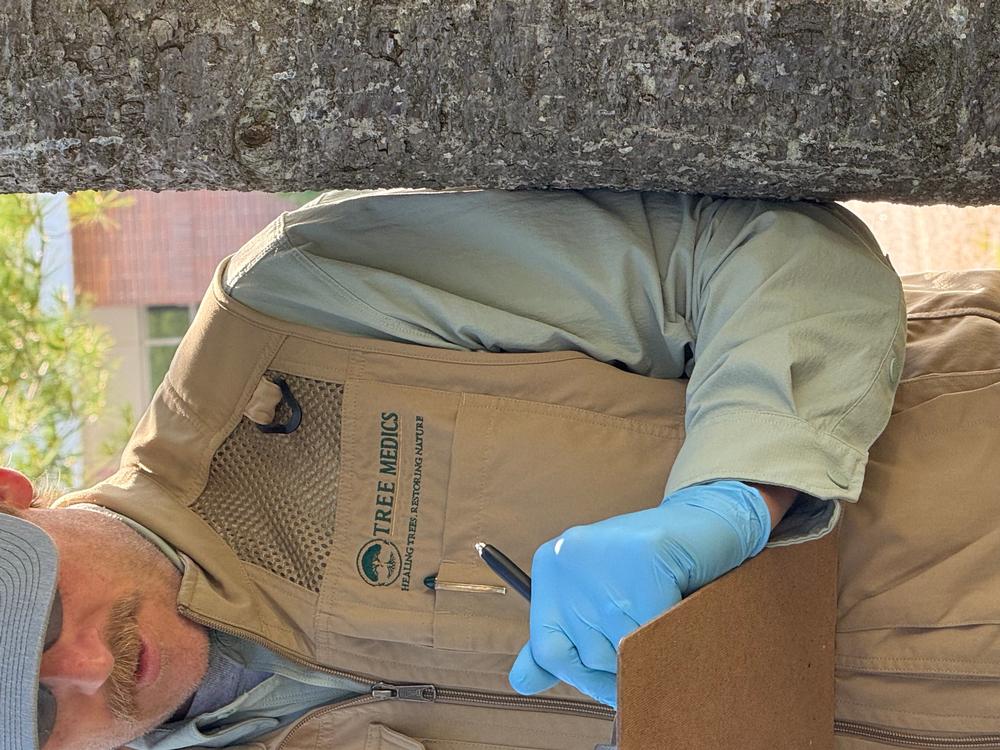
People often ask us, “Is my ash tree still savable?” More often than not, the honest answer is “it depends.” Some people will tell you that you can judge an ash tree by its canopy alone, and that is usually the place to start, but the tree’s overall health, its surroundings and the weather all play a part. Here is how we think it through, and what the research says.
Signs your ash tree has emerald ash borer
- Thinning and dieback starting in the upper third of the canopy[1]
- Clusters of shoots or branches growing below the dead part of the trunk[1]
- Small D-shaped exit holes in the bark, left by adult beetles in spring[2]
- S-shaped tunnels under the bark where larvae have fed[2]
- Vertical splits in the bark[2]
- Woodpeckers stripping bark to reach the larvae, leaving pale patches often called “blonding”[1]
Early infestations are hard to spot. Trees with only a few larvae often show no outward signs, and nearly all infestations have been at least four to six years old by the time anyone noticed them.[3]
How far gone is it? Start with the canopy
Compare the crown to how full it should be for a healthy ash of that size. The amount of canopy already lost is the best single guide to whether treatment still makes sense.
If your ash is already on a treatment plan, continue it.[4] A tree that was declining when treatment started may keep declining for the first year before it improves in the second.[3]
Why waiting makes removal harder
Emerald ash borer damage is cumulative, and the dead parts of the tree never come back.[4] As the larvae destroy the tissue that carries water, the tree dries out and its wood becomes brittle. Breaks are often hidden under the bark, so large limbs can fall without warning, even on a calm day. Structural weakening can begin while the tree still looks mostly green.[4]
Timing also affects cost. Tree crews will not climb an ash that has been dead for more than about six months, so a crane may be needed, which raises the price of removal.[1] A dying ash near a house, driveway or play area should not be a do-it-yourself job.[4]
When to start protecting healthy ash
The national guidance is to consider treatment once ash trees with obvious signs of emerald ash borer are within 30 miles.[3] In Southern Maine that line was crossed years ago: York and Cumberland counties were placed under quarantine in 2020,[5] and the beetle has since been found in Portland.[6] Treating too early can waste money, but in our area most valuable ash trees are now worth protecting or at least assessing.
Treatment options
A trunk injection of emamectin benzoate gave excellent control for up to three years from a single spring treatment in several studies. Imidacloprid soil treatments and sprays generally have to be repeated every year.[3] Read more about how we treat on our emerald ash borer treatment and tree injection pages.
Reporting emerald ash borer
If you find signs of emerald ash borer in a Maine town where it has not been found before, report it to the Maine Forest Service with photos. In towns already known to have it, sightings can be shared through platforms such as iNaturalist.[7]
If emerald ash borer is close to your property, the best thing to do is call Tree Medics and start monitoring your ash trees before the damage shows. Call or text (207) 303-7291 or book a tree assessment.
Sources
- University of Maryland Extension: Emerald ash borer (updated September 2026)
- USDA APHIS: Emerald ash borer
- Herms, McCullough, Sadof, Smitley, Miller and Cranshaw: Insecticide options for protecting ash trees from emerald ash borer, 3rd edition (North Central IPM Center, 2019)
- Purdue Landscape Report: Avoid deadly risk of dying ash trees with timely tree removal (January 2019)
- Maine Forest Service: EAB found in seven more Maine towns, with York and Cumberland counties under quarantine (2020)
- Maine DACF: Emerald ash borer discovered in Portland, Maine’s “Forest City”
- Maine Forest Service: Report emerald ash borer